Torno al "lontano 2007" per raccontare come ho recuperato e modificato il mio primo Baidarka
Ne ho trovato uno su eBay, in Scozia, l'ho scelto sulla base di queste foto ed ho vinto l'asta per 340 sterline.
I go back to "longtime ago 2007" to tell how I recovered and modified my first Baidarka
I found one on eBay, Scotland, chose it based on these photos and won the auction for 340 pounds.

Si tratta di un Baidarka costruito dalla McNulty (pre P&H) nel 1978
It is a Baidarka built by McNulty (pre P&H) in 1978
Dopo averlo acquistato ho dovuto aspettare alcuni mesi per averlo in Italia (per non pagare un trasporto salatissimo); quando l'ho ricevuto sono rimasto un po' deluso dalla pedaliera a sbarra e dai gavoni costuiti a filo dei tappi (dietro al sedile una voragine che si riempiva di acqua e non si svuotava girando il kayak), davanti a i piedi 1/2 metro prima della paratia, gavone anteriore piccolissimo.
Per il resto barca OK, costruzione veramente solida nonostante avesse quasi 30 anni.
After buying it, I had to wait a few months for it to be in Italy (to avoid to pay a very high price); when I received it I was a bit disappointed by the footbar and the bulkheads built very close to the hatches (behind the seat a larg volume that filled with water and did not empty when turning the kayak), in front of the feet 1/2 meter before the bulkhead, very small front hatch volume).
For the rest boat was OK, really solid construction despite being almost 30 years old.
La pompa dietro il pozzetto è una vera chicca... ma del tutto inutilizzabile (scomodissima!)
The pump behind the cockpit is really nice... but completely unusable (very akward!)
Ho quindi preso coraggio a 2 mani e ho deciso di rendere il kayak più moderno e marino.
So I picked up some courage and decided to make the kayak more modern and more seaworthy.
Non avendo mai usato la vetroresina non avevo la minima idea di cosa fare; per fortuna che il buon Riccardo Rovida mi ha aiutato con lunghe telefonate di consiglio. Provvidenziali anche gli sfridi di pannelli in PVC espanso e di tessuto di vetro che mi ha regalato.
Having never used fiberglass, I had no idea what to do; luckily my good friend Riccardo Rovida helped me with long phone calls for advice. Also providential are the scraps of expanded PVC panels and glass fabric that he gave me.
Ho dunque tagliato via le due paratie (anteriore e posteriore), il sedile e ho rimosso la pompa.
So I cut off the two bulkheads (front and rear), the seat and removed the pump.
La paratia posteriore avrei potuto lasciarla ma inizialmente volevo fare solo due gavoni quindi pensavo di avanzarla dietro al sedile, poi ho deciso di fare tre gavoni e l'ho dovuta rifare...!
Questo mi serva di lezione per ragionare prima di agire...
I could have left the rear bulkhead but initially I only wanted to make two hatches so I thought of moving it behind the seat, then I decided to make three hatches and I had to do it again ...!
This will serve as a lesson for me to think before doing...
Togliere la paratia anteriore e i due listoni porta sbarra dei piedi mi è costato qualche serata infilato nel pozzetto a mo' di topo dentro un tubo con in mano un seghetto.
Removing the front bulkhead and the two footbar costed me a few evenings slipped into the cockpit like a mouse inside a pipe with a hacksaw in hand.
Alla fine stufo della lentezza sono entrato con una mola a disco... ma non lo consiglio perchè si lavora male e si respira uno sproposito di polvere (infatti dopo la prima sera mi sono portato dal lavoro una maschera pieno facciale con i filtri classe P4 antipolvere)
E' anche poco sicuro perchè se la mola si impunta te la tiri sul muso e incastrato come sei non hai il tempo di ritrarti e ciò potrebbe avere conseguenze perlomeno spiacevoli.
In the end, tired of the slow progress, I went in with a disc wheel ... but I don't recommend it because you work badly and you breathe a lot of dust (in fact after the first evening I brought a full face mask with class P4 dustproof filters from work )
It is also unsafe because if the grinding wheel sticks you pull it on the nose and stuck as you are, you don't have time to withdraw and this could have at least unpleasant consequences.
Notare nella foto come il sotto del ponte sia armato di costole di rinforzo.
Notice in the photo how the underside of the bridge has reinforcement ribs.
Usando dei pannelli di PVC espanso ho creato delle nuove paratie, sia davanti che dietro.
Le ho tagliate alla buona, ricoperte con tessuto di vetro e resina e poi, una volta asciutte, le ho rifilate poco per volta per farle calzare giuste nello scafo.
Using expanded PVC panels I installed new bulkheads, both front and rear.
I cut them roughly, covered with glass and resin fabric and then, once dry, I trimmed them little by little to make them fit right into the hull.
La paratia dietro al sedile l'ho creata avvolgente per dare massimo volume al terzo gavone e per lasciare meno acqua possibile nel pozzetto.
I created the bulkhead behind the seat curved to give maximum volume to the third hatch and to leave as little water as possible in the cockpit.
Beata ingenuità delle prime costruzioni ho laminato doppio da entrambi i lati!!
Avevo lasciato la paratia avvolgente al sole ad asciugare in cortile, per distrazione facendo la retro ci sono passato sopra con la macchina...niente!! Non si è nemmeno scalfitta.
Mi sono reso subito conto di avere sprecato materiale e messo peso per niente, la robustezza è tale che uno strato da una sola parte è più che sufficiente.
Blissful naivety of the first constructions I laminated double on both sides !!
I had left the wraparound bulkhead in the sun to dry in the courtyard, out of distraction by rearing with my car I went over it with ... nothing !! It hasn't even been scratched.
I immediately realized that I had wasted material and put on weight for nothing, the strength is such that a layer on one side is more than enough.
Quando si è trattato di fissare le paratie è venuto il Riccardo a casa mia e assieme abbiamo piazzato la paratia anteriore fermandola con tanti piccoli fazzoletti di resina.
Non è stato facile perchè de dentro non si arrivava alla paratia se non con un pennello su legno di prolunga e ...sembra facile fare un lavoro preciso...
Comunque presa la mano sono andato avanti da solo e ho fissato tutte le paratie.
When it came to fixing the bulkheads Riccardo came to my house and together we placed the front bulkhead, fixing it with many small resin patches.
It was not easy because inside you could not get to the bulkhead except with a brush fixed on and extension stick and ... it not so easy to do a precise job ...
Anyway, I got practice and went on alone and fixed all the bulkheads.
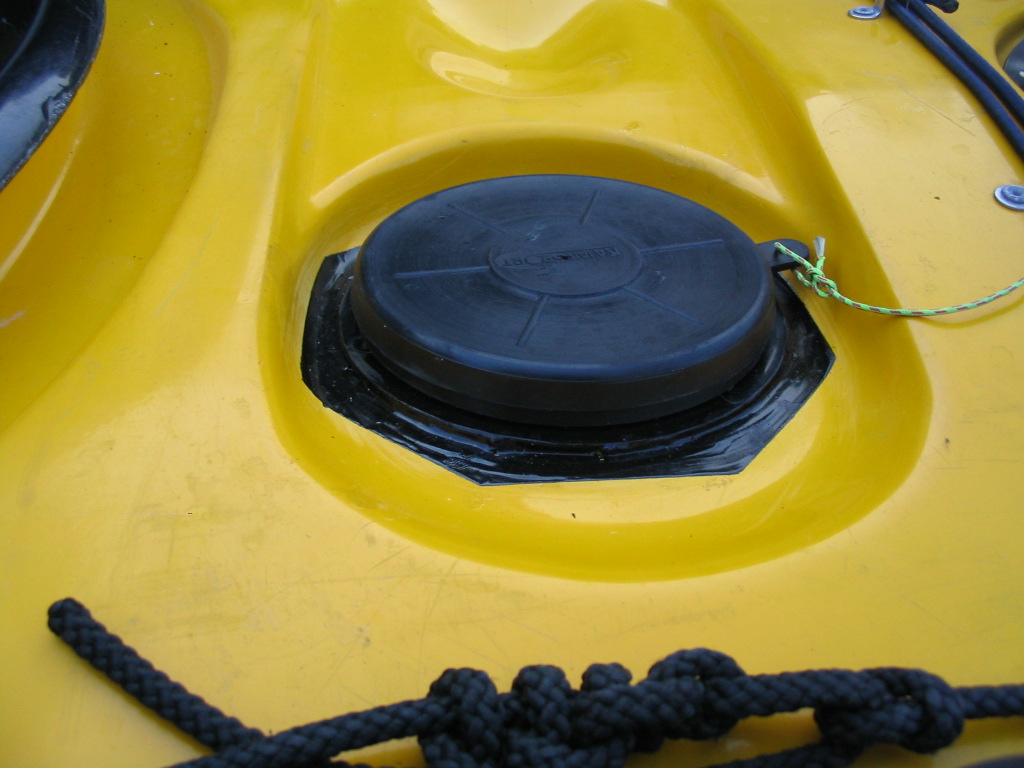
Il buco della pompa dietro l'ho recuperato come mini tappo per il terzo gavone; avrei potuto fare di meglio ma non volevo tagliare i ponti (non si modifica la carrozzeria delle vecchie glorie!).
Il foro di uscita l'ho chiuso con qualche fazzoletto di tessuto e resina.
I reused the pump hole behind the cockpit as access for the day hatch; I could have done better but I didn't want to cut the deck (you don't change the bodywork of the old glories!). I closed the pump outlet hole in the hull with some resin patches.
Il tappo l'ho acquistato da CS Canoe che molto efficientemente ti manda tutto a casa: ghiera, tappo e sikaflex per fissarlo.
I bought the hatch cover from CS Canoe which very efficiently sends you everything at home: rim, cover and sikaflex to fix it.
Come sedile ho scelto quello di un Avanaq e l'ho adattato in maniera analaoga a come spiego nel post del 12 gennaio 2011 per il Sirius (lavoro che ho fatto sulla base di questa prima esperienza).
As a seat I chose that of an Avanaq and I adapted it in a similar way to how I explain in the post of January 12, 2011 for the Sirius (work I did based on this first experience).
Come finitura ho passato del gel coat bianco dentro lo scafo e i gavoni, ho messo una gomma punta piedi (non ho voluto fare la paratia esatta per me, ho lasciato 7-8 cm in più per poter prestare la barca a chi è più alto di me) e ho cambiato i cordami elastici del ponte.
As a finish, I layered some white gel coat inside the hull and the hatches, I put a foam block as foot support (I didn't want to install the bulkhead just for me, I left 7-8 cm more to be able to lend the boat to those who are taller than me) and changed the bungee cords of the deck.
Non sapendo come evitare che il gel coat colasse, per fare un buon lavoro ho scelto un ...ehmm... layout di lavoro fantasioso.
Not knowing how to stop gel coat from flowing and making droplets, to do a good job I chose a ... ehmm ... fancy work layout.
Il risultato è stato molto soddisfacente, il pozzetto è pulitissimo, comodo e imbarca il meno possibile di acqua.
The result was very satisfactory, the cockpit is very clean, comfortable and carries as little water as possible.
Il sedile si vede ancora fissato temporaneamente con delle viti (una prova prima di resinare era d'obbligo)
The seat is still temporarily fixed with screws (a test before fixing with fiberglass was a must)
A marzo del 2008 ho potuto varare la barca nella sua nuova configurazione.
In March 2008 I was able to launch the boat in her new configuration.